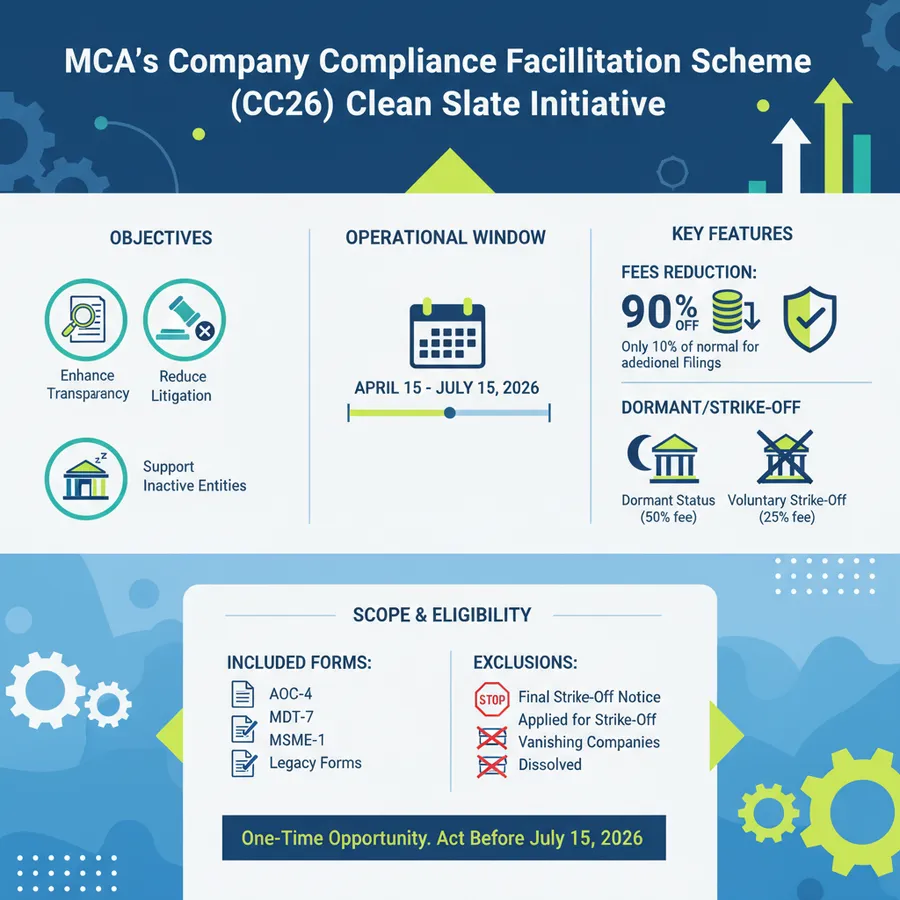
To bolster corporate governance and support the "Ease of Doing Business" initiative, the Ministry of Corporate Affairs (MCA) has introduced the Companies Compliance Facilitation Scheme (CCFS), 2026. Notified via General Circular No. 01/2026 on February 24, 2026, this scheme offers a one-time opportunity for defaulting companies to regularize their statutory filings and clear long-standing compliance backlogs with minimal financial burden.
The CCFS-2026 is specifically designed to help companies—especially MSMEs, startup ventures, and dormant entities—achieve a clean slate by offering substantial waivers on additional fees and immunity from certain legal repercussions.
Objectives of CCFS-2026
The primary objective of the CCFS-2026 is to ensure that the electronic registry maintained by the MCA is accurate and up-to-date. By incentivizing compliance, the government aims to:
- Enhance Transparency: Ensure that financial statements and annual returns of all registered companies are available for public inspection.
- Reduce Litigation: Lower the burden on the judiciary and regulatory authorities by encouraging voluntary compliance over prosecution.
- Support Inactive Entities: Provide a cost-effective exit or hibernation strategy for companies that are not currently operational.
Operational Window
The CCFS-2026 is a time-bound initiative, operational for a period of three months:
- Commencement Date: April 15, 2026
- Closing Date: July 15, 2026
Companies are encouraged to take advantage of this window early to avoid last-minute technical delays on the MCA21 portal.
Key Features and Financial Incentives
The scheme offers several unprecedented benefits for companies that have failed to file their statutory documents on time:
1. Massive Reduction in Additional Fees
Under normal circumstances, late filing of forms like AOC-4 or MGT-7 attracts an additional fee of ₹100 per day of delay, with no upper limit. Under CCFS-2026, companies can file pending documents by paying only 10% of the normal additional fees that would have otherwise been applicable.
2. Immunity from Prosecution
One of the most significant aspects of the scheme is the grant of immunity. Companies that utilize the scheme to file overdue documents will be granted immunity from penalties and prosecution proceedings specifically related to the delay in filing. This immunity applies to filings made before an adjudication notice is received or within 30 days of such a notice. However, it is important to note that any penalties already imposed by adjudication orders prior to the scheme’s announcement must still be paid.
3. Facilitation for Dormant Status and Strike-Off
For companies that are no longer active but wish to remain on the register, the scheme allows for an application for "Dormant Company" status (Form MSC-1) at only 50% of the normal filing fee. Conversely, companies wishing to close their operations permanently can apply for a voluntary strike-off (Form STK-2) by paying only 25% of the prescribed fee.
Scope and Eligibility
The CCFS-2026 applies to a wide range of e-forms under the Companies Act, 2013, and the Companies Act, 1956.
Commonly Included Forms
- AOC-4 / AOC-4 CFS / AOC-4 XBRL: Financial Statements.
- MGT-7 / MGT-7A: Annual Returns.
- ADT-1: Appointment of Auditors.
- MSME-1: Half-yearly returns regarding outstanding payments to MSMEs.
- Legacy Forms: Various forms under the 1956 Act (e.g., 20B, 23AC, 23ACA).
Exclusions
The scheme is not universal. It does not apply to:
- Companies against which a final notice for striking off has already been initiated by the ROC under Section 248.
- Companies that have already applied for voluntary strike-off.
- Vanishing companies.
- Companies already dissolved through amalgamation or liquidation.
Conclusion
The Companies Compliance Facilitation Scheme, 2026, represents a rare "clean slate" opportunity for the Indian corporate sector. By drastically reducing the cost of compliance and removing the threat of prosecution, the MCA provides a clear pathway for businesses to return to good standing.
Following the conclusion of the scheme on July 15, 2026, authorities are expected to take stringent regulatory action against entities that remain non-compliant. Therefore, it is highly recommended that directors and stakeholders review their compliance status immediately. If you require professional assistance in evaluating your company’s eligibility or managing the filing process under this scheme, you may contact our expert team here for a detailed consultation.
Professional adherence to these timelines will not only save significant costs but also safeguard the company and its directors from future legal complications.